Δdriftlessv0.2 seed · 2026
deck/cover 01 / 10
Driftless

Driftless

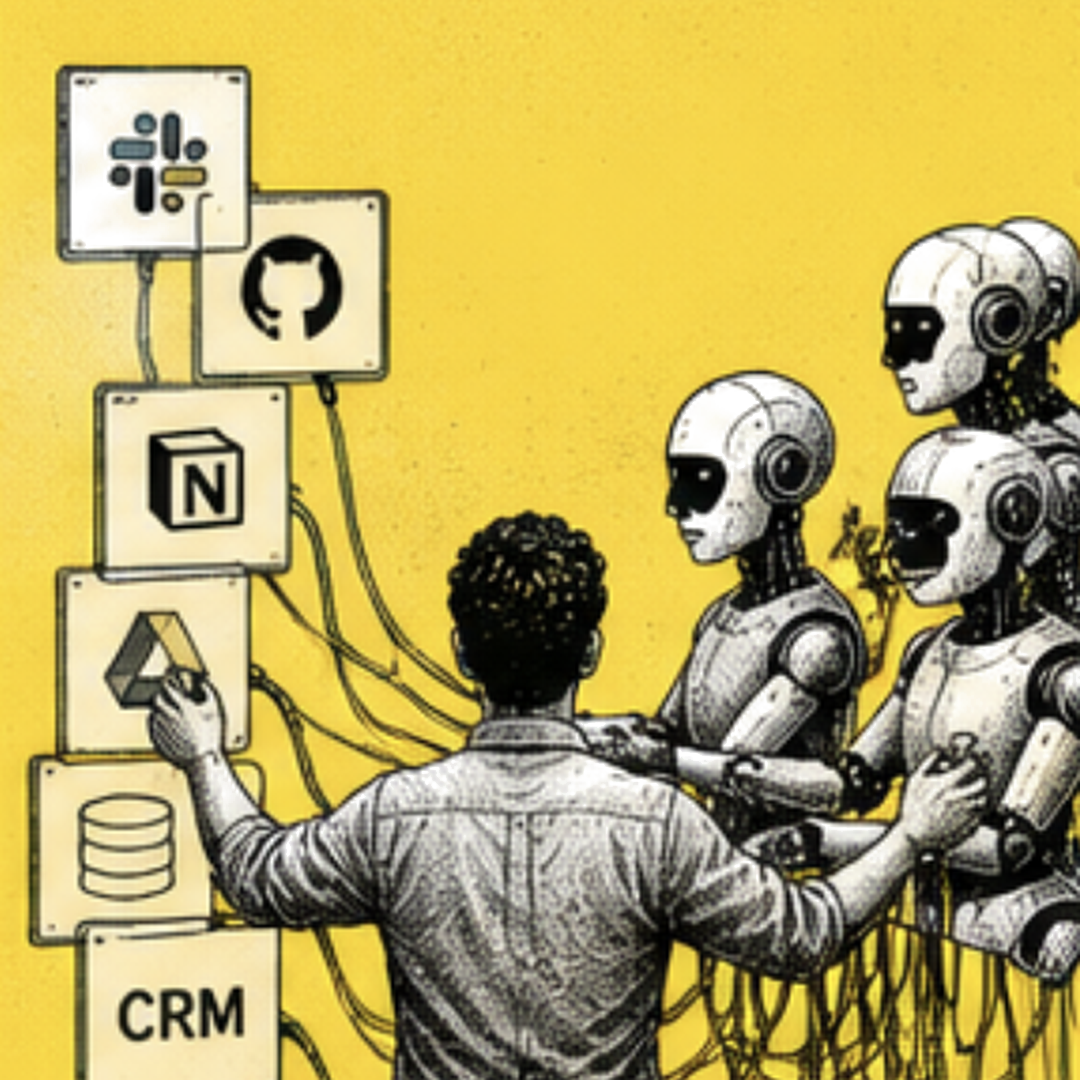
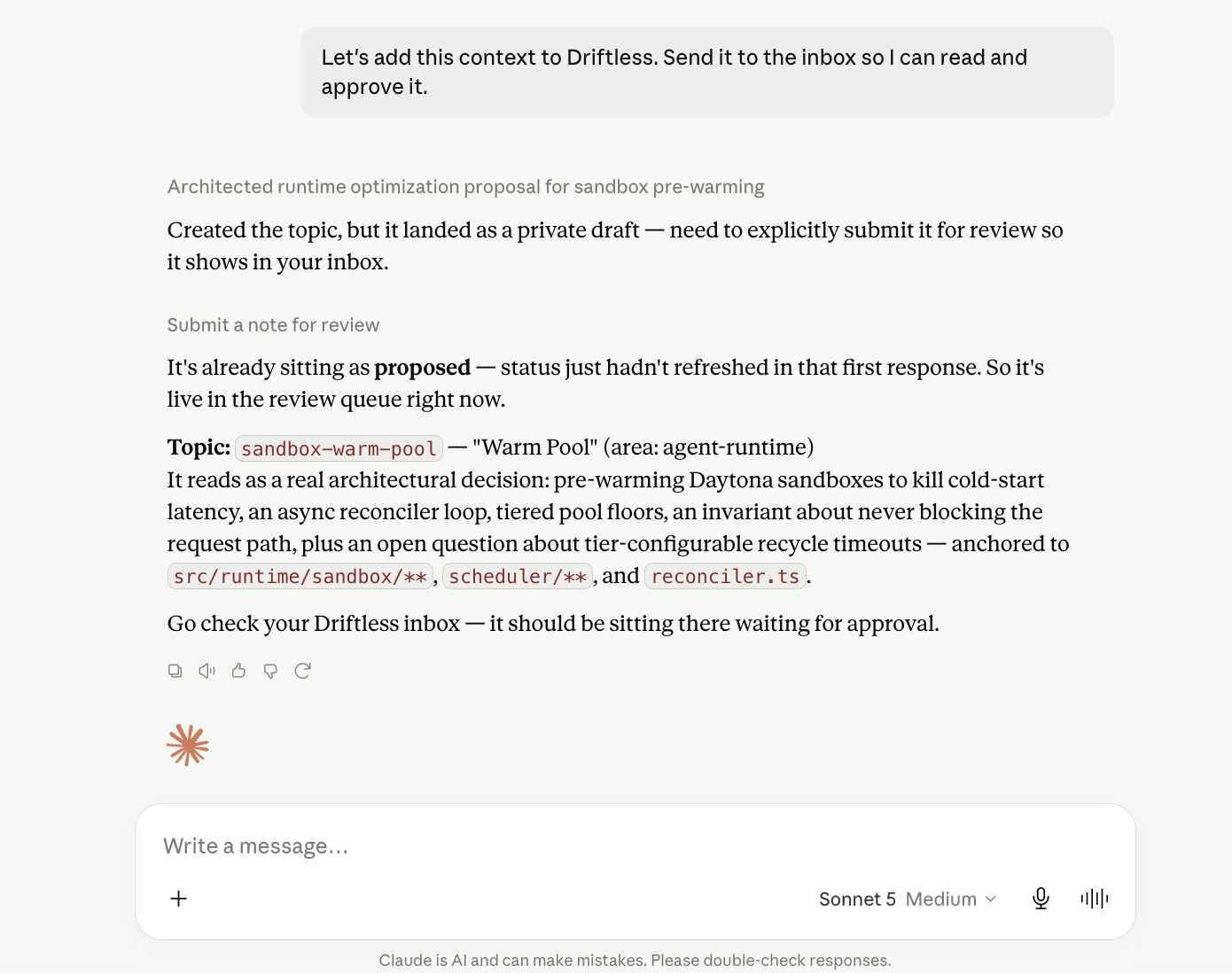
Agents don't just consume context.
They create it.

Driftless turns what agents and humans learn into durable engineering memory — reusable across sessions, agents, and teams.

Starting with production code, where missing context is most expensive.

CLI · Looking for 5–10 design partners · driftless.icu
Δdriftless 02 · the shift
deck/why now 02 / 10
02 why now

AI made software work faster.
It did not make systems easier to understand.

As agents enter engineering workflows, the bottleneck is no longer just generating changes. It is delivering the right system context to the right human or agent at the right moment.

use or plan to use AI tools
84%
of developers · Stack Overflow 2025
distrust AI accuracy
46%
vs. 33% who trust it · Stack Overflow 2025
top frustration
66%
"almost right, but not quite" · Stack Overflow 2025

Sources: Stack Overflow Developer Survey 2025.

Δdriftless 03 · problem
deck/problem 03 / 10
03 problem

The bottleneck moved from generation to context delivery.

Engineering context already exists — in code, PRs, incidents, docs, Slack, meetings, and prior agent sessions. The problem is that it arrives too late, in the wrong shape, or not at all.

  • Knowledge is scattered. Slack, retros, PR comments, wikis, senior engineers' heads.
  • Nothing is anchored to code. Docs don't know which files they describe.
  • Agents can't read it. Threads and tribal knowledge aren't structured input.
time spent searching for answers
61%
of developers spend > 30 min / day looking · Stack Overflow 2024
knowledge silos hit productivity
30%
10+ times per week · Stack Overflow 2024
debugging AI-generated code
45.2%
say it's more time-consuming · Stack Overflow 2025
Δdriftless 04 · concrete example
deck/failure mode 04 / 10
04 what goes wrong

The code changed. The context didn't arrive.

~/acme-platform on feat/sso-orgs PR #4291
# agent edits 14 files under src/auth/** $ git push build green · tests pass · PR opened ───────────────────────────────── what the agent could not see: · tenant resolution must precede org lookup → rule lived in an incident retro · cache key must include org_id → rule lived in a Slack thread · fixtures must exclude prod claims → rule lived in a senior eng's head $

The code is fine.
The system rule isn't.

Auth, billing, webhooks, permissions, multi-tenant boundaries — every team has load-bearing rules that live nowhere a coding agent can read them.

The cost shows up as review churn, reverts, and incidents — not as a failing test.

built from daily CTO use
We use Driftless internally to map:
  • · Cross-repo multi-tenant business guards
  • · Onboarding paths for humans and agents
  • · Feature and webhook flows
  • · MCP / internal ops workflows
  • · Architectural decisions, gotchas, and invariants

Notion stored notes. Driftless delivers context.

Δdriftless 05 · product
deck/product 05 / 10
05 product

Topics are reusable onboarding
for humans and agents.

auth-flow topic · rev 0143
anchors src/auth/** apps/api/middleware/session.ts
what Resolves user, org, and tenant scope before any business logic runs.
gotchas Tenant resolution must happen before org lookup. Cache key must include org_id.
invariants Test fixtures exclude production claims. requireOrgId(req) precedes tenant work.
owners @platform-team
checks auth.integration.test.ts
relations depends_onjwt-service risk_fortenant-isolation

A topic captures what matters about a part of the system.

What it does, how it works, gotchas, invariants, owners, required checks, related systems — all anchored to code paths.

The same topic can onboard a new hire, guide a coding agent, inform a reviewer, and survive into future sessions.

  • · Stale-aware — code changes flag affected topics
  • · JSON-first output — agents read it natively
  • · --human for terminal-readable rollups
  • · Lives in .driftless/ in your repo
Δdriftless 06 · workflow
deck/demo 06 / 10
06 workflow

Driftless delivers the right context at the moment work happens.

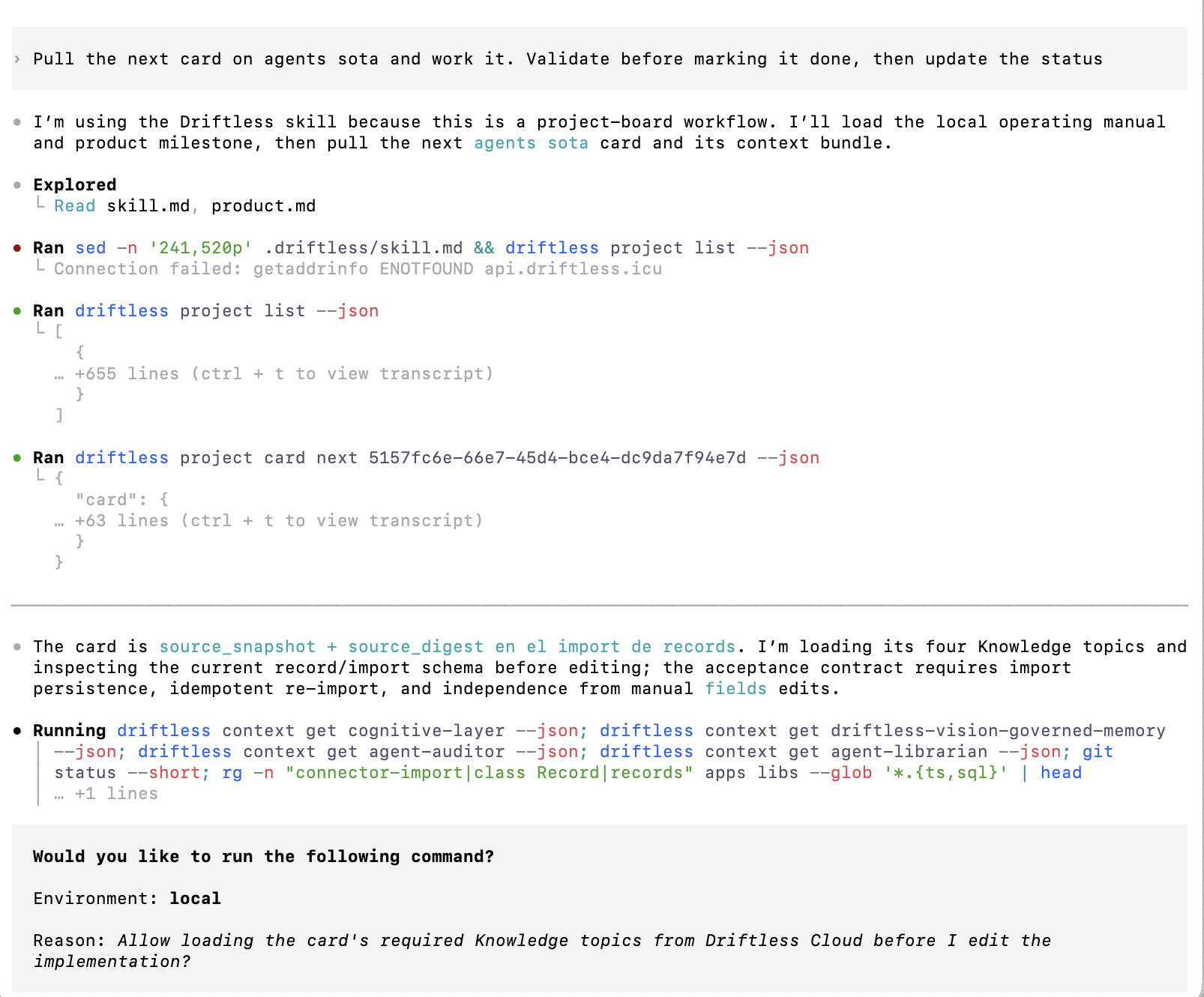
~/acme-platform on feat/sso-orgs context load
$ driftless context load \ --files "src/auth/**" → scanning 14 files → resolving topics ............ done → checking anchors against HEAD → piping to agent stdin 3 topics matched ├─ auth-flow rev 0143 ├─ jwt-service rev 0081 └─ tenant-isolation rev 0072 4 gotchas · 6 invariants 2 owners · 3 required checks ! 1 stale topic tenant-isolation ! 2 uncovered files in this diff $
context output · json → agent
{ "topic": "auth-flow", "anchors": ["src/auth/**"], "gotchas": [ "tenant resolution before org lookup", "cache key must include org_id" ], "invariants": [ "requireOrgId() precedes tenant work", "test fixtures exclude prod claims" ], "owners": ["@platform-team"], "checks": ["auth.integration.test.ts"], "relations": [ "depends_on: jwt-service", "risk_for: tenant-isolation" ], "stale": false, "rev": 143 }

Edit-time is the wedge. The same memory delivers during onboarding, reviews, incidents, and future sessions.

Δdriftless 07 · beachhead
deck/beachhead 07 / 10
07 beachhead

Beachhead: AI-heavy TypeScript teams with complex production repos.

Where coding agents already ship daily, where one wrong edit hurts, and where senior engineers are tired of being the live context layer.

load-bearing areas we target
auth
session, tenants, org boundaries
billing
invoices, proration, refunds
permissions
RBAC, scopes, multi-tenant
webhooks
idempotency, retries, ordering
platform
internal SDKs, core libs
onboarding
new hires + new agents
design-partner fit
  • TypeScript / Node repos in production
  • Active Cursor / Claude Code / Copilot use
  • 20–500 engineers, multi-team monorepo
  • Risky areas: auth, billing, webhooks, perms
  • Reviewing agent-generated PRs already
why this wedge first

We start with code because it is high-stakes, easy to anchor, and already where agents are working. TS is the AI-coding-agent native ecosystem today. These teams already feel the pain weekly, can install a CLI tonight, and have load-bearing repos worth protecting.

Δdriftless 08 · market
deck/market 08 / 10
08 market · scenario

Large adjacent market. Category still open.

This starts as an engineering workflow wedge and expands into context delivery infrastructure for agentic work. Modeled, not claimed. Adjacent AI dev tools — Copilot Business / Enterprise, Cursor — already normalize $20–$40 per seat per month. Driftless attaches to that same seat.

conservative
$1.2B
5M serviceable seats × $20/mo
Floor scenario — TS-heavy AI-first teams only.
base case
$3.6B
10M serviceable seats × $30/mo
AI coding adoption keeps current trajectory.
upside
$7.2B
20M serviceable seats × $30/mo
Agentic coding crosses majority of professional seats.

Signals supporting the trajectory: 1M+ agent-created PRs on GitHub in 5 months 1.13M+ public repos importing an LLM SDK (+178% YoY) 51% of pro developers use AI tools daily

Sources: GitHub Octoverse 2025; Stack Overflow Developer Survey 2025; Copilot & Cursor public pricing.

Δdriftless 09 · competition
deck/competition 09 / 10
09 competition

Existing tools solve fragments of context delivery.

category what they do well where they fall short for context delivery
Code search / repo intel
Sourcegraph, Cody, GitHub search
Find code across large repos. No durable team memory. Stateless. No invariants, owners, or gotchas.
IDE copilots / coding agents
Copilot, Cursor, Claude Code
Generate and edit code in-context. Don't own repo context across sessions. Re-derive system rules every time. Agent-created context dies at session end.
Docs & wikis
Notion, Confluence, READMEs
Human-readable narrative. Detached from work time. Not anchored to files. Stale by default. No session memory.
Enterprise knowledge search
Glean, Guru, internal search
Find documents across the company. Not code-anchored. Doesn't know which files a rule applies to. Doesn't deliver at workflow time.
PR review automation
CodeRabbit, Graphite, Greptile
Catch issues on PR. Act after the change. Driftless delivers context before and during the work.
▌ Driftless Captures durable engineering memory. Anchors it to code. Delivers it to humans and agents. Updates it across sessions. Context delivery infrastructure for agentic work. Stale-aware. JSON-first. Survives sessions.

Our claim: No single incumbent clearly owns durable context delivery for agents at work time. Each category solves one slice. Driftless is the layer that unifies them.

Δdriftless 10 · status & ask
deck/ask 10 / 10
10 where we are

Built v0.2.
Now proving
the workflow.

Driftless v0.2 turns engineering knowledge into code-anchored topics and delivers it to humans and agents during real work.

We're opening seed conversations to prove one thing: context delivery becomes a repeated workflow for teams letting agents touch production code.

If we prove that, Driftless becomes the memory layer for agentic engineering.

what exists
  • CLI
  • Repo scanner + topic model
  • File / path anchors
  • context load command
  • Stale topic detection
  • JSON-first agent output
  • Dogfooding on Driftless
what we prove next
  • 5–10 production teams use Driftless weekly
  • Topics become reusable onboarding for humans & agents
  • Agent sessions write back durable context
  • Risky code areas become visible and covered
  • Context delivery becomes a repeated workflow
try it yourself

Agent: build a semantic layer for your repo.

Optimized for NestJS backends and Next.js / React frontends.
If driftless init fails, the agent still maps topics, relationships, gotchas, and coverage gaps.

— Driftless · v0.2 · seed conversations open

jose@driftless.icu · driftless.icu · npm i -g @driftless-sh/cli